
One of the most relevant issues in mathematics and particularly among middle and high school students is trigonometry. It is concerned with the correlation of angles and sides of a triangle. Trigonometry is challenging to most students initially, however, as soon as they learn the basic formulae and do them step by step, solving trigonometric problems are far easier.
This blog will teach us how to Solve Trigonometric Problems With Formulae in a simple and helpful manner.
What Is Trigonometry?
The study of angles and sides of a right-angled triangle is the area of mathematics known as trigonometry. The term trigonometry is derived out of two Greek words:
Trigonon – triangle
Metron – measure
Applications Trigonometry is commonly applied in the areas of engineering, physics, architecture, navigation and astronomy.
Simple Trigonometric Ratios
Prior to arriving at a solution, one has to be aware of the six fundamental trigonometric ratios. These ratios are characterized of a right-angled triangle.
The Six Trigonometric Ratios.
Sine (sin 0 ) = Opposite / Hypotenuse.
Cosine (cos 0 0 ) = Adjacent / Hypotenuse.
Tangent (tan 0 ) = Opposite/ Adjacent.
Cosecant (cos c 0 ) = Hypotenuse/ Opposite.
Secant (sec 0 ) = Hypotenuse /Adjucent.
Cotangent (cot 0 ) = Opposite / Adjacent.
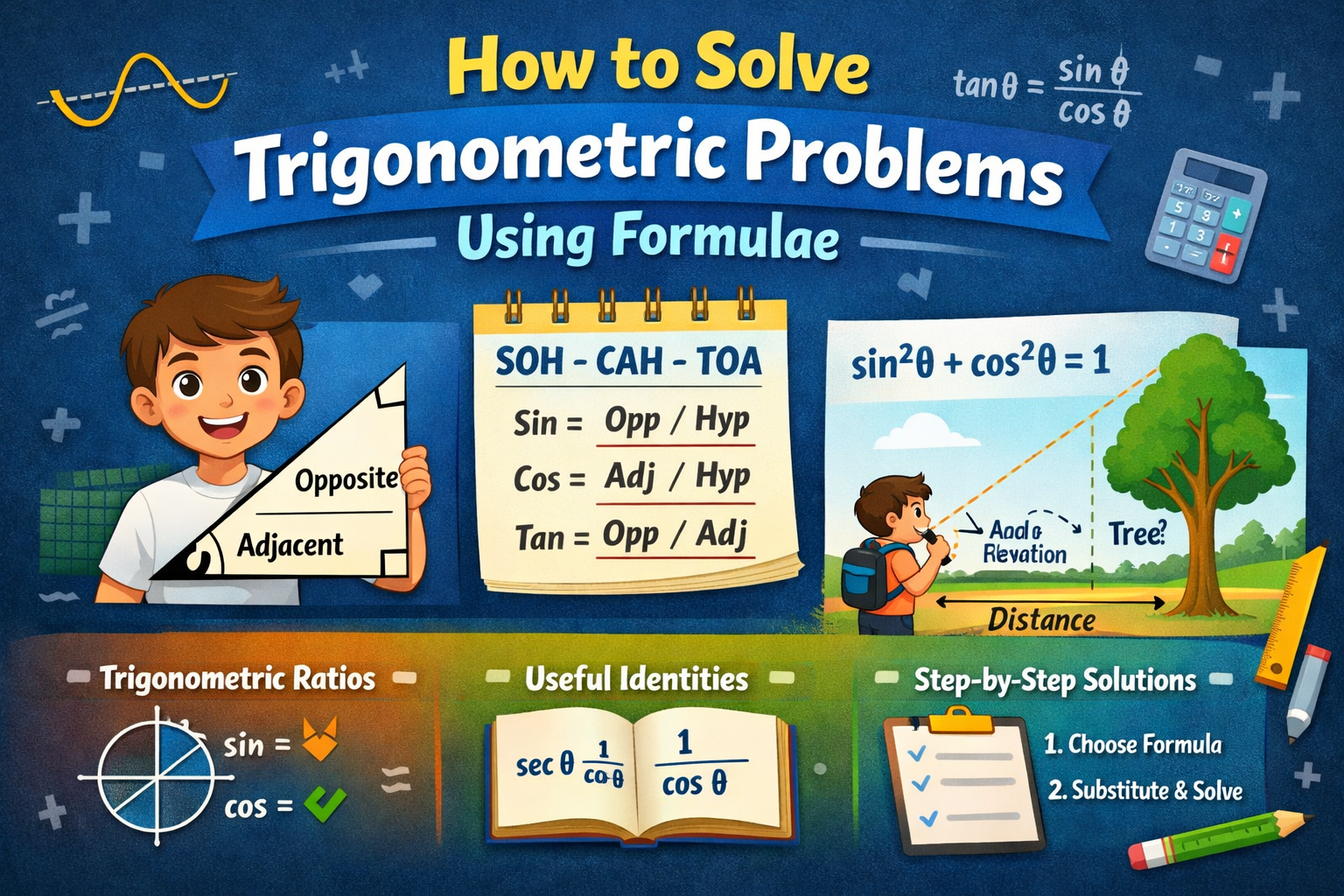
The first 3 ratios are most often remembered in the form of SOH-CAH-TOA:
SOH → Sin = Opposite / Hypotenuse
CAH → Cos = Adjacent / Hypotenuse
TOA → Tan = Opposite / Adjacent
Standard Trigonometric Formulae
The formulae are useful in solving trigonometric problems. The most frequently used identities include:
Reciprocal Identities:
cosec θ = 1 / sin θ
sec θ = 1 / cos θ
cot θ = 1 / tan θ
Quotient Identities:
cosec θ = 1 / sin θ
sec θ = 1 / cos θ
cot θ = 1 / tan θ
Quotient Identities(h3)
tan θ = sin θ / cos θ
cot θ = cos θ / sin θ
Pythagorean Identities(h3)
sin²θ + cos²θ = 1
1 + tan²θ = sec²θ
1 + cot²θ = cosec²θ
Learning these formulae enables one to solve problems more quickly and effectively.
Procedures to Find the Trigonometric Problems by Formulae
To work out the trigonometric problems, it is necessary to use the following simple steps:
Step 1: Carefully read the question to determine what is given and what needs to be found.
Step 2: If needed, sketch a rough diagram of the triangle.
Step 3: Determine the angle used and name the sides (perpendicular, base, hypotenuse).
Step 4: Choose the proper formula or trigonometric ratio.
Step 5: Use the formula in place of the given values.
Step 6: To arrive at the final solution, simplify the step.
Solving Trigonometric Value Problems
The problems tend to require you to determine the value of a trigonometric ratio.
Example:
Find the value of sin 30°.
Based on standard trigonometric values:
sin 30° = 1 / 2
Similarly:
sin 45° = 1 / √2
cos 60° = 1 / 2
tan 45° = 1
Acquisition of these standard values facilitates fast calculations.
Identities(h2)Solving Problems.
In questions of identity, we are aiming to show that the left hand side (LHS) is equal to the right hand side (RHS).
Solving Identity Problems
Tips.
- Begin on the complex side of the equation.
- Turn any ratios to sin and cos.
- Apply trigonometric functions such as sin 2 theta + cos 2 theta = 1.
- Break down a complex process into simple steps and avoid overlooking the process.
- Do not alternate both sides simultaneously.
Solving Word Problems
Some of the real life scenarios where trigonometry is used include the calculation of heights and distance.
Problems With Words:
- Determining the height of a building or a tree.
- Determining the distance of an object to the ground.
- Angles of elevation and depression.
Problem Solving Steps
- Read the problem carefully.
- Draw a labelled diagram.
- Determine the degree of elevation or depression.
- Choose the right trigonometric ratio.
- Replace the values and find the solution.
Common Mistakes to Avoid
When students are solving trigonometric problems, they usually commit the following mistakes:
- Making an incorrect trigonometric ratio.
- Leaving out the use of the right formula.
- Confusion of degrees and radians.
- Omission of steps in simplification.
- Failure to draw a diagram on word problems.
- These errors can be avoided and thus accuracy can be enhanced greatly.
Advice to Learn Trigonometry
- Practice problems daily.
- Learn conventional formulae and values.
- Learn concepts and not by heart.
- Rewrite identities frequently.
- Test previous exam questions.
Conclusion
Trigonometry is also simple in the event that students are well aware of the fundamental proportions, formulas and identities. It is easy and even fun to solve trigonometric problems using formulae by taking them step by step and practicing. It is possible to develop confidence with regular practice and get good grades by passing exams.